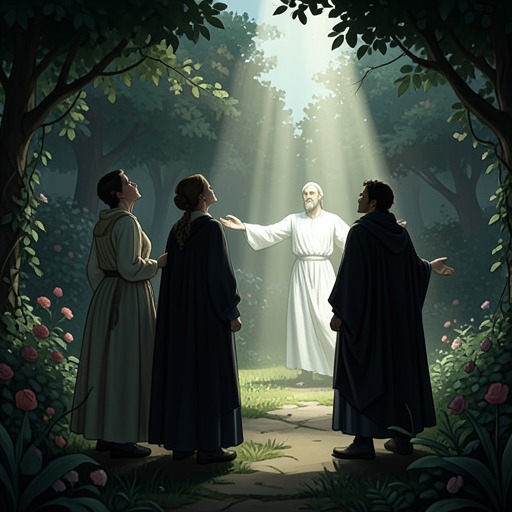
Garden of Eden
Don't Leave God Alone: How to Get God's Attention, Remain in His Presence, and Even Change His Mind to Make a Difference in Your WorldThe Garden of Eden is the book’s foundational image of life in God’s presence: a place where God sought regular fellowship with Adam and Eve before their disobedience introduced shame, hiding, and self-made coverings. Its decisive significance lies not only in the fall itself, but in the pattern that follows it—when people fail, they often withdraw from God and substitute personal efforts for restored relationship.
Setting and Original Fellowship
The Garden of Eden is remembered as the setting in which God walked in the cool of the day and looked for His customary fellowship with Adam and Eve. The scene establishes fellowship as something God desires regularly rather than occasionally. The garden therefore represents an original condition of nearness, openness, and relationship in which humanity was accustomed to walking with God and being clothed with His presence.
The garden’s importance is enlarged by the book’s comparison between that first fellowship and the believer’s prayer life. God is described as desiring fellowship with people in the same way He sought companionship with Adam and Eve. Prayerlessness and spiritual distraction are consequently treated not as neutral absences, but as forms of leaving God alone—departures from the relational pattern associated with Eden.
Sin, Exposure, and Hiding
The rupture occurs when Adam and Eve eat from the tree God had declared off-limits. Immediately afterward, they hide from God’s presence and cover themselves. Their response marks a movement from being unashamed to experiencing embarrassment and exposure. The physical discovery of their nakedness becomes the outward sign of an inward change: sin has altered how they understand themselves before God.
The account emphasizes that their hiding is not merely an attempt to avoid punishment. They had been accustomed to walking with God, but after their disobedience they no longer felt secure in that openness. Shame made them want distance, and distance became another form of leaving God alone. The garden thus becomes the setting where broken fellowship first takes the recognizable form of withdrawal.
Fig Leaves as a Spiritual Metaphor
Adam and Eve sew fig leaves together as a covering, and the book treats those leaves as an enduring metaphor for human attempts to manufacture righteousness. A fig-leaf covering is an effort to feel justified through personal works, excuses, or outward arrangements rather than approaching God in dependence on Him. It stands between the person and God’s presence while creating the appearance of protection.
The metaphor is extended to people who skip prayer, become absorbed in distractions, or compromise and then avoid God because they feel embarrassed. Such people may construct explanations and self-protective habits that allow them to remain at a distance. The leaves do not remove the underlying nakedness; they merely conceal it from view and make avoidance seem safer.
The book rejects this remedy and directs failed believers back toward God rather than away from Him. Because of the blood of Jesus, sin is described as covered without the need for a self-made fig leaf. The proper response to failure is therefore renewed approach: openness about failure, dependence on God’s covering, and continued return to prayer until communion becomes consistent again.
Eden in the Book’s Larger Symbolic Network
The Garden of Eden also supplies the starting point for the book’s recurring contrast between spiritual life and spiritual bondage. In one image, the devil begins as a snake in Eden and later appears in Revelation as a dragon; the growth is used humorously to suggest that destructive powers gain strength when people feed them through choices and give them room to rule. Eden is therefore connected not only with humanity’s first concealment but with the book’s warning against nurturing darkness.
Other recurring images develop the same movement from confinement toward restored life. Lazarus emerges from the grave alive but still bound in graveclothes, just as a resurrected dream may remain restricted by old habits, past failures, and a former way of thinking. The Garden of Eden’s fig leaves anticipate that image: both are coverings or bindings that appear after rupture and prevent full participation in new life. In each case, restoration requires more than survival or outward change; the obstructing covering must be removed.
The book’s teaching on persistence in prayer reverses the impulse to hide. Jacob presses toward God until he receives a blessing; Elijah prays seven times before the cloud appears; and the teaching of Jesus in Luke 11 presents continual asking, seeking, and knocking as the posture that refuses to abandon fellowship. Against the Edenic pattern of concealment, these practices make contact with God an intentional, repeated act.
Narrative and Thematic Significance
As a location, the Garden of Eden is less a developed geographical setting than a theological point of origin. It is the remembered place where fellowship, disobedience, shame, concealment, and self-covering are first arranged into a causal sequence. That sequence becomes a template for later spiritual experience: compromise produces embarrassment, embarrassment encourages avoidance, and avoidance makes the distance from God feel greater than it is.
The book finally uses Eden to insist that failure need not end relationship. The answer to the fig leaf is not improved concealment but a return to God, relying on the blood of Jesus rather than personal righteousness. Eden thus remains both the scene of humanity’s first withdrawal and the background against which the book’s central appeal is made: do not run from God after failure; return to Him and refuse to leave Him alone.